

INDIGENOUS ARTWORK
We are proud to announce a commissioned Indigenous artwork that will be created for and displayed at the RACI National Congress 2026, taking place at the Perth Convention and Exhibition Centre in Boorloo (Perth), Western Australia.
The artwork has been commissioned from Erika Fernandez, a Yamatji, Naaguja and Wajarri woman with Chilean Mapuche heritage, who was born and raised in Boorloo. Erika’s work is deeply connected to storytelling, culture, and the natural world, using colour and symbolic patterns to express relationships between people, place, and knowledge.
Created especially for RACI 2026, the piece brings together the worlds of chemistry and Country. Flowing lines and intricate dot work symbolise atoms moving and interacting, representing the unseen elements that shape our world. Earthy reds, warm ochres, deep blues and browns reflect the land and waters of Western Australia, while vibrant rainbow colours reference chemical elements and the Rainbow Serpent, the powerful creator spirit in many Aboriginal cultures.
The artwork tells a story of connection between science and nature, people and Country, and the shared responsibility we all hold to care for the world around us. It serves as a powerful reminder that chemistry is not separate from nature, but part of the living systems that sustain us.
Delegates attending RACI 2026 will have the opportunity to view this special piece on display at the Perth Convention and Exhibition Centre throughout the congress.
We gratefully acknowledge the generosity of the UWA University Appeal donor community, whose support made this commission possible. Their philanthropy has enabled the creation of a significant and enduring work that celebrates Indigenous knowledge, fosters learning and dialogue, and enriches the experience of all who engage with it.
ERIKA FERNANDEZ
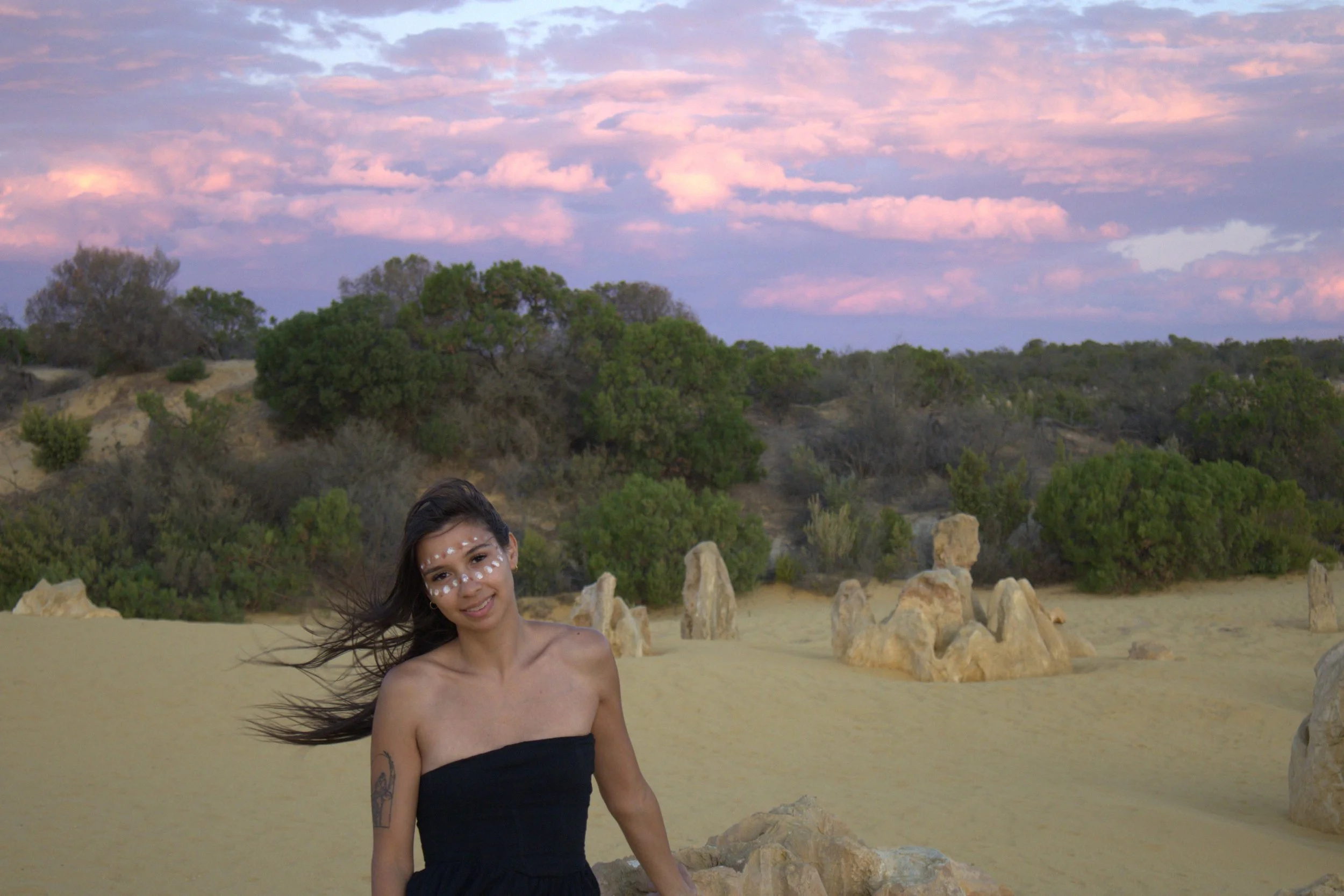
My name is Erika Fernandez, a Yamatji/Naaguja/Wajarri and Chilean/Mapuche woman, born in Boorloo (Perth), where I have spent most of my life.
Art has always been a part of who I am. I grew up surrounded by creativity, I began to deeply connect with the beauty and storytelling of Aboriginal art. When I became pregnant, I turned to painting as a way to support my mental health. After my daughter was born, I started sharing my work with my family and then the world.
That was the beginning of my journey as an artist, and I haven’t looked back since.
As abstract submissions have been extended until 2nd of March, reviewing will commence on the 3rd of March. The program committee aims to have notifications out by the end of March.
If this is an issue for travel/visas please let us know RACI2026@asnevents.net.au.
PRESENTATION TYPES
Oral Presentation
Poster Presentation
ABSTRACT CATEGORIES / DIVISIONS
Analytical & Environmental Chemistry Division
Carbon Chemistry Division
Chemical Education Division
Green and Sustainable Chemistry Division
Electrochemistry Division
Health, Safety & Environment Division
Industrial Chemistry Division
Inorganic Chemistry Division
Materials Chemistry Division
Medicinal Chemistry & Chemical Biology Division
Organic Chemistry Division
Physical Chemistry Division
Polymer Chemistry Division
Radiochemistry Division
Supramolecular Chemistry Division
Grand Challenges
SUBMISSION STEPS
Select the presentation type and Category/Division it belongs to (should your abstract align with multiple categories/divisions, you will have the option to select additional categories/divisions at a later stage of the submission process).
Provide some keywords to assist in categorisation of your abstract.
Enter the title of your abstract. Please type the title in sentence case (that is lowercase with only the first letter or the first word in capitals) and without any punctuation. A correctly formatted example follows: Title of my presentation for the conference.
Enter the name of all authors and their organisations and indicate the presenting author by ticking the relevant box.
Type or cut and paste the text of your abstract/synopsis into the relevant field. Please ensure the abstract is no more than 300 words. (Does not include title, authoring or cited references)
Preview your abstract, make any changes required and finalise your submission and return to your dashboard.
You will receive an email confirmation that your abstract has been successfully submitted. Please check your email junk file in case it has been captured there.
Should you wish to make any changes to your abstract after you have submitted it, please log onto your online registration dashboard. Click on the “View Submission” then “Preview/edit abstract”.
****Please note you will only be able to make changes to your abstract until the submission deadline.
GRAND CHALLENGE
During the registration process, presenters will be offered the option to tick a box if they would also like their talk considered for a Grand Challenge session (if they have not registered directly for the session). This will allow conference organisers to ensure the seven streams are populated with both new scientific ideas and application/implementation methods.
-
This stream will target both chemical and environmental engineers, focussing on the basis for identifying and remediating contaminants in natural waterways and the environments they support. Further, the stream can extend to the role of climate change in affecting the distribution of water across ecosystems, enabling disciplinary participation from ecology and climatic (computational) modelling.
-
Explores Earth's geological and environmental history through an interdisciplinary lens not limited to geology, geochemistry, geobiology, geophysics, organic geochemistry and palaeontology. It focuses on the role of advanced analytical technologies, critical minerals, geonomics, biomarker geochemistry and computational modelling to understand past life, extinction events, and geological processes. The session also aims to provide insights into future climate and environmental challenges by examining past extinction events and their connection to climate change.
-
This stream primarily targets chemical and electrical engineers in its focus on decarbonization of conventional energy sources, growth and support for renewable energy generation, and – critically – the enabling pathways for the production and utilisation (combustion) of alternative fuels, particularly for chemical vectors of energy storage and transmission.
-
This stream focusses on advanced production methods for emergent materials, including the use of additive manufacturing, novel catalysts and reactions, and frontier purification technologies. The role of advanced pharmaceutical manufacturing is of particular interest in the session, as the complexity and individualisation of pharmaceuticals continues to increase.
-
This stream aims to explore the role of chemistry and machine learning (AI) in novel technologies to enable personalised health monitoring and disease detection, alongside agricultural science and technology to enable resilient food production and distribution. The impact of improved agriculture on climate change, food scarcity, and human health provide tremendous opportunities to deploy innovative chemistry.
-
This stream focusses on the advanced dimensions of modelling that would not traditionally be found in RACI Divisions (e.g., DFT in Physical Chemistry). Within this, the stream aims to explore the physics and chemistry behind emergent quantum computers, alongside the advanced methods for data compression/prediction (machine learning, ensemble learning) and simulation (computational fluid dynamics and molecular dynamics) that benefit from such computational breakthroughs.
-
This stream targets both novel technologies to capture carbon (drawing heavily on absorption and adsorption in chemical engineering) alongside emergent utilisation (reaction engineering) and storage/monitoring (reservoir engineering and geoscience). Across all three domains, the stream will seek to unite the development of novel chemistries (e.g., new adsorption materials) and processes (e.g., direct air capture).
COMMITTEE REVIEW
The Conference Committee will review all submissions before selecting the presentations which will be included in the conference program.
ACCEPTANCE NOTIFICATION
Once the review process has been completed, the conference organisers will notify all submitting authors of the outcome of their abstract.
You will be advised whether your abstract is accepted or not, and specific presentation instructions will be included where applicable.
Notification will go out by the end of April 2026.